

Teachers are always looking for ways to engage students in meaningful, inquiry-driven learning. In a Project-based Learning (PBL) classroom, students don’t just absorb information, they explore, question, and create. However, before they can dive into a complex project, they need a strong foundation of knowledge so that they are equipped to ask meaningful questions and drive their own learning.
This is where NotebookLM’s Audio Overview (Podcast) feature becomes a game-changer. By generating AI-powered audio summaries, teachers can develop and support active listening, scaffold inquiry, and encourage student-driven research. Best of all, these summaries can be customized to fit different learning goals. Before you “Generate” an Audio Overview, you need to click on the “Customize” button to get the most out of this feature. I have used trial and error to develop prompts that help me get the best “podcast” for my students.
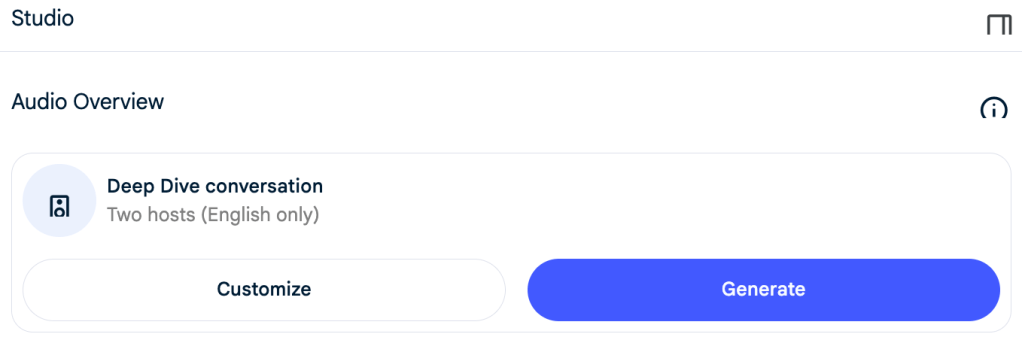
- A key limitation to keep in mind is that customized prompts must be 500 characters or fewer, so crafting the right wording is essential. Below, I’ll explore how to maximize this tool in a PBL setting with practical strategies, sample prompts, and classroom applications.
To maximize the quality of your audio summaries, consider structuring your prompts in one of three ways:
1. Engaging Prompts: Sparking Student Interest
If your goal is to hook students’ attention, an “engaging” prompt creates a conversational tone that connects concepts to students’ interests and real-world relevance.
Example Prompt:
“Generate an engaging audio summary of European Exploration for 8th graders. Use simple language, relatable examples, and analogies. Highlight explorers’ impact on the Americas and connect it to modern issues. End with a thought-provoking question to spark curiosity.”
- Best for: Middle schoolers who need accessibility and motivation to stay focused.
This prompt generated a podcast length of 15 minutes based on a one paragraph summary in the source content.
2. Concise Prompts: Focused & Straight to the Point
A “concise” prompt produces a shorter summary that sticks strictly to the facts. This style is ideal when you want students to receive key information quickly without additional context or connections.
Example Prompt:
“Provide a concise audio summary of European Exploration for 8th graders. Cover key explorers, motivations, and impact on the Americas. Keep the language simple and straightforward, focusing on essential facts.”
- Best for: Time-limited lessons, review sessions, or when students already have background knowledge.
This prompt provided a podcast length that was 13 minutes based on a one paragraph summary in the source content.
3. Storytelling-Style Prompts: Making Learning Immersive
If you want to deepen student engagement, a “storytelling-style” prompt blends historical content with narrative elements. This approach provides a richer, more immersive experience by weaving events into a compelling story.
Example Prompt:
“Create a storytelling-style audio summary of European Exploration for 8th graders. Use a narrative approach to explain key events, explorers’ journeys, and impacts. Weave in relatable characters or scenarios to help students connect emotionally to the topic.”
- Best for: PBL projects, students who learn best through contextual storytelling, and deeper content exploration.
This prompt created a podcast length that was 20 minutes based on a one paragraph summary in the source content.

This QR Code links to a Google Doc of prompts that you can customize for your content.
How NotebookLM’s Customized Audio Overview Enhances PBL
1. Building Background Knowledge Before a Project
Every great project begins with curiosity and context. If students are researching climate change, ancient civilizations, or space exploration, they need a broad understanding before they can narrow their focus and develop research questions or a project idea for how they want to demonstrate their mastery of the content.
Try customizing using this prompt:
“Generate an overview of [topic] that provides essential background knowledge for students beginning a project on [PBL topic].”
Example:
“Generate an overview of renewable energy that provides essential background knowledge for students beginning a project on sustainable city planning.”
Classroom Strategy: While listening, students jot down key facts, highlight unfamiliar terms, and brainstorm potential driving questions for their project.
2. Guiding Inquiry and Driving Questions
A strong PBL unit revolves around Overarching Essential and Topical Essential Questions that spark student curiosity. NotebookLM’s Audio Overviews can frame real-world challenges and help students develop their own lines of inquiry.
Try customizing using this prompt:
“End the conversation with a thought-provoking question related to [real-world problem] that encourages students to investigate further.”
Example:
“End the conversation on climate change with the question: How can your community transition to 100% renewable energy, and what challenges might arise?”
Classroom Strategy: After listening, students brainstorm additional driving questions to guide their research and project work.
3. Encouraging Active Listening for Research
In a PBL setting, students must analyze and synthesize information, not just passively consume it. Providing a structured handout can help them track key takeaways, including:
- Unfamiliar Terms (to look up later)
- Key Names & Locations (historical or global relevance)
- W.O.W. (Worthy of Wonder) Facts (unexpected discoveries)
- Questions for Further Exploration

This QR Code links to a Canva Template that I created for a worksheet students use while listening to the “podcast.”
Try customizing with this prompt:
“Break down [difficult term or concept] using simple explanations and relatable examples.”
Example:
“Break down the concept of ‘colonial mercantilism’ using simple explanations and relatable examples.”
Classroom Strategy: Students collaborate in small groups to work through what stood out to them. This allows for collaboration and synthesis before exploring how they would like to apply the information to their projects.
4. Empowering Students to Customize Their Learning
One of the best aspects of NotebookLM is that students can refine their focus within a broader topic, a crucial skill in PBL. The audio overview may bring up a connection that the student would have missed all on their own, but it gives them great direction in how they want to explore the content.
Try customizing with this prompt:
“Summarize [complex topic], emphasizing [specific subtopic], so students can explore it in their PBL project.”
Example:
“Summarize climate change, emphasizing its impact on coastal cities, so students can explore it in their PBL project.”
Classroom Strategy: Allow students to generate their own driving questions based on specific subtopics related to their project focus.
5. Making Real-World Connections
A core principle of PBL is authentic learning, helping students see how the learning and projects connect to their world. NotebookLM’s audio overviews can include current events, industry applications, and expert insights to deepen relevance.
Try customizing with this prompt:
“Relate [topic] to a current issue or innovation to help students see its real-world impact.”
Example:
“Relate artificial intelligence to current innovations in education to help students see its real-world impact.”
Classroom Strategy: After listening, students discuss how their project topic applies to different careers, industries, or societal challenges.
Beyond the Summary: Next Steps for PBL Integration

1. Student-Generated Questions
Once students have listened to the audio overview, encourage them to write their own driving questions tailored to their research questions.
2. Peer Collaboration and Discussion
Have students compare what stood out to them and the areas that they want to explore further, discuss what they found confusing, and share ideas for how they want to approach the project before beginning deeper research.
3. Reflection and Assessment
Encourage students to reflect on their learning by answering:
- What was the most surprising or impactful idea from the audio overview?
- How did this information shape my project focus?
- What unanswered questions do I still have?
This can be done individually, with partners, or in groups.
Bringing It All Together
NotebookLM’s Audio Overview isn’t just a passive summary tool, it’s a springboard for deep learning and inquiry. When used intentionally in a PBL framework, it helps students:
- Build essential background knowledge before launching into a project
- Develop their own research questions and lines of inquiry
- Actively listen and take structured notes for deeper understanding
- Customize content to deepen their specific project focus
- Make connections between learning and the real world
By integrating this tool into your PBL classroom, you’re not just giving students information, you’re equipping them with the skills to explore, question, and create solutions to real-world problems.
How do you see yourself using AI-generated summaries in your PBL classroom?


 modernpbl.com
Leave a comment